Beyond the Bottom Line: Why Sustainable Business Practices Are the New Competitive Advantage
For most of the twentieth century, businesses operated under a simple mandate: maximize shareholder returns. Environmental stewardship, social responsibility, and ethical governance were considered admirable extras — the domain of corporate philanthropy, not corporate strategy. That era is over.
The Sustainability Imperative: From Margin to Mainstream
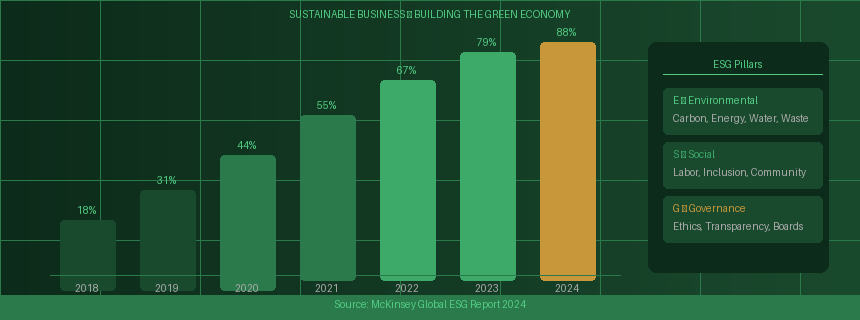
Figure 2: Growth in ESG strategy adoption among Fortune 500 companies (2018–2024)
A profound shift has reshaped the strategic landscape of global business. Sustainability — once dismissed as a cost center or a public relations exercise — has emerged as one of the most powerful drivers of competitive advantage, investor confidence, talent attraction, and long-term organizational resilience. Companies that lead on Environmental, Social, and Governance (ESG) criteria are not sacrificing profit for principle. They are discovering that purpose and profit are not opposites. They are partners.
The data is unambiguous. A landmark study by Eccles, Ioannou, and Serafeim (2014) tracking 180 companies over eighteen years found that businesses with strong sustainability cultures significantly outperformed their conventional peers in both stock market performance and accounting-based metrics. More recently, MSCI’s 2024 ESG Ratings analysis revealed that companies in the top ESG quartile demonstrated 27% lower cost of capital and 40% lower volatility during market downturns compared to low-ESG peers.
The message to boards, CEOs, and management teams is clear: sustainability is no longer optional. It is strategic.
Understanding ESG: The Three Pillars of Sustainable Business
The ESG framework provides the dominant architecture for measuring and communicating sustainability performance. Its three pillars — Environmental, Social, and Governance — encompass the full spectrum of an organization’s non-financial impact and risk exposure.
Environmental
The Environmental pillar addresses an organization’s relationship with the natural world: carbon emissions, energy consumption, water stewardship, waste management, biodiversity impact, and exposure to climate-related risks. With the global average temperature tracking above 1.5°C above pre-industrial levels, climate risk has migrated from environmental concern to mainstream financial risk — directly affecting insurance premiums, supply chain stability, regulatory exposure, and physical asset values.
Social
The Social pillar encompasses how organizations manage relationships with their human ecosystem: employees, suppliers, communities, and customers. This includes labour standards and fair compensation, health and safety practices, diversity and inclusion, community investment, and supply chain ethics. A 2024 Deloitte survey found that 77% of Millennial and Gen Z workers consider a company’s sustainability commitments before accepting a job offer.
Governance
The Governance pillar addresses the systems, structures, and norms that ensure accountability, transparency, and ethical conduct in organizational decision-making. Strong governance encompasses board diversity and independence, executive compensation alignment with long-term value creation, robust anti-corruption frameworks, and transparent disclosure of both financial and non-financial performance.
The Business Case for Sustainability: Evidence Across Dimensions
Access to Capital
Global ESG assets under management exceeded USD 35 trillion in 2024, representing more than 35% of all professionally managed assets worldwide. Institutional investors increasingly integrate ESG assessments into their investment mandates. Companies with strong ESG credentials access capital at lower cost, attract a broader investor base, and face lower risk of divestment campaigns.
Operational Efficiency and Innovation
Sustainable operations are frequently more efficient operations. Interface, the global carpet manufacturer, demonstrated that its pursuit of zero environmental footprint generated over USD 500 million in cumulative cost savings through waste elimination and energy efficiency over two decades, while simultaneously reducing its carbon footprint by 96%.
Talent Attraction and Retention
Gallup’s 2024 State of the Global Workplace report found that employees at sustainability-leading organizations report 43% higher engagement scores and 31% lower voluntary turnover. In an era of acute skills shortages across knowledge industries, these differences translate directly into competitive capability.
Regulatory Resilience
The regulatory environment for sustainability is tightening rapidly. The European Union’s Corporate Sustainability Reporting Directive (CSRD), the SEC’s climate disclosure rule, and carbon pricing mechanisms in over 70 jurisdictions are raising the financial cost of greenhouse gas emissions. Companies that have proactively built sustainability management systems are structurally better positioned.
Key Takeaways
- ESG leaders demonstrate lower cost of capital, higher investor confidence, and superior long-term financial performance.
- Climate risk is mainstream financial risk — directly affecting asset values, insurance, and supply chain stability.
- Circular economy principles drive both cost efficiency and new revenue generation through innovative business models.
- Sustainability is a talent imperative: purpose-driven organizations demonstrate dramatically higher engagement and retention.
- Regulatory requirements are tightening globally — proactive sustainability management is structural competitive advantage.
From Strategy to Practice: Embedding Sustainability in Operations
A McKinsey survey (2024) found that while 83% of executives consider sustainability ‘important’ or ‘very important’, only 34% report having a comprehensive sustainability strategy linked to financial targets and executive accountability.
Research by the Carbon Disclosure Project (CDP, 2023) demonstrates that up to 90% of most organizations’ environmental footprint resides upstream in their supply chains, not in their direct operations. Sustainable supply chain management is therefore central to any credible corporate sustainability strategy.
Leadership commitment is the non-negotiable foundation. Sustainability strategies that lack board-level ownership, CEO championing, and executive compensation linkage rarely achieve meaningful impact.
Conclusion
The question facing business leaders in 2025 is no longer whether to embed sustainability into organizational strategy. The regulatory environment, investor expectations, consumer preferences, talent dynamics, and physical realities of climate change have rendered that question obsolete. The only live question is how — and how quickly.
Organizations that move boldly and authentically toward sustainable business models will shape the competitive landscape in their industries, attract the capital and talent they need to grow, build the stakeholder relationships that sustain long-term license to operate, and create enduring value for shareholders and society alike.
Sustainability is no longer a trade-off against competitiveness. It is the engine of competitiveness — for the organizations willing to lead rather than follow.