Sciences Po president: ‘I don’t like the word “elite”’
Inside Luis Vassy’s office at Sciences Po’s historic headquarters in Paris, there is an enormous round table stacked with dozens of books. From French philosopher Michel Foucault to Austrian biographer and novelist Stefan Zweig, some of Europe’s most celebrated thinkers are on display.
Asked what he’s currently reading, the Sciences Po president reaches for The World of Yesterday, Zweig’s 1942 memoir of a Vienna transformed by nationalism and two world wars. One detail that stood out to him, he says, is how student movements can be co-opted by far-right groups and used to intimidate opponents. As he likes to tell his students, “protests are not always a good thing”.
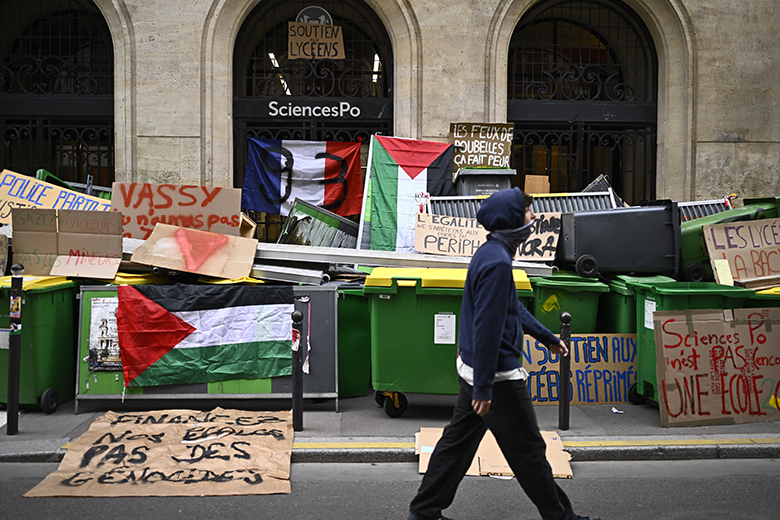
Our interview is taking place at a time when huge youth protests have erupted across France. Dilapidated schools, a shortage of teachers, overcrowded classrooms and frustration with the university admissions process have driven thousands of high school pupils to the streets across the country, sometimes resulting in violent clashes with police. Some university campuses, too, have been blockaded.
But Vassy is sympathetic to the students’ grievances. He hears a generation worried about “its future, job integration, climate change…the fairness of the [university] selection process, including these elite institutions that we represent”.
Source:
Julien de Rosa/AFP via Getty Images
A career diplomat, Vassy was France’s ambassador to the Netherlands and a cabinet director to the minister for Europe and foreign affairs. But for all his diplomatic skills, the first two years of his five-year term have not been free of protest and controversy either – although, in recent years, that has become par for the course at the famous Paris grande école whose alumni include President Emmanuel Macron (a former classmate of Vassy’s) and generations of French political and business leaders.
Vassy’s predecessor, Mathias Vicherat, resigned after he and his former partner were sent to trial over mutual allegations of domestic violence. Vicherat’s own predecessor, Frédéric Mion, had stepped down three years earlier amid criticism of his handling of sexual abuse allegations against Olivier Duhamel, then head of the foundation overseeing Sciences Po.
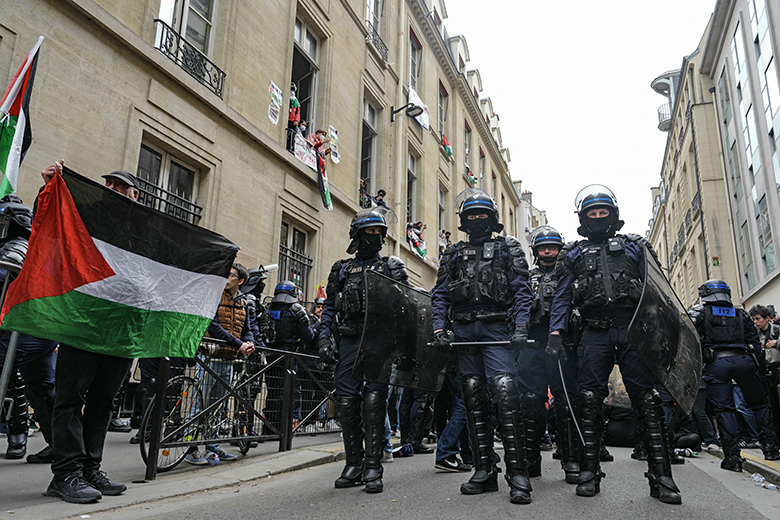
By the time Vassy arrived in 2024, the institution had also seen months of pro-Palestinian student protests, inspired by Gaza solidarity encampments at campuses in the US. “Things were pretty tense when I first took on the role: let’s put it that way,” he said.
And tensions remain. In April, 145 professors and researchers – more than half of Sciences Po’s permanent faculty – signed a statement criticising what they called Vassy’s “unilateral” leadership style. The immediate trigger was Vassy’s decision to call the police to remove pro-Palestinian students occupying a lecture hall, resulting in 76 students being searched, photographed and fined €400 (£338) each for trespass.
“Such fines and the threat of a criminal record are unprecedented in the history of student activism at Sciences Po,” the academics’ statement read. The fines were imposed even though “the protest was proceeding without violence or property damage”, the statement asserts, and they reflect “a desire to criminalise activities that are part of a long-standing tradition in higher education institutions. Student mobilisation is an integral part of students’ intellectual and civic development, particularly at an institute of political studies”.
Vassy, however, stands by his decision to call the police. “Some of the professors that signed that text are of the view that blockading the institution is part of the freedom of speech of students,” he said. “I think it’s a valid debate. But I stand by my position that freedom of expression doesn’t extend to the ability to blockade the [university] because [doing so] infringes on the freedom of expression of other students.”
Academics quoted in a Le Monde article published in May also expressed concerns about Vassy’s unilateral interventions in academic matters, including cancellations of specific courses, such as “understanding and containing total war in the 21st century” and his addition of three new ones, including one on geopolitics taught by himself. But Vassy, who has also overhauled Sciences Po’s bachelor’s programme to add more mathematics, political philosophy and a course on academic writing, said he was always open to discussions on curricular matters
He also rejected criticism of his appointment of Hugo Micheron, as a high-profile researcher into European jihadism, even though the university’s scientific council voted against it, pointing out that the “extremely powerful” body’s vote is only advisory when it comes to adjunct positions. The council had backed all his other decisions, he added, but he noted that any ripple of discontent within such a prominent institution was always likely to be picked up by journalists.
“Anything that happens [at Sciences Po] will be national coverage. If I spill my water now, I can guarantee you there will be an article in [a French newspaper] tomorrow,” he said. But he remains in contact with almost all the faculty members who signed the critical statement about his response to the Palestine protest. “We can disagree: it doesn’t mean there needs to be huge tensions,” he said.
Source:
Dimitar Dilkoff/AFP via Getty Images
Indeed, he sees such disputes as part of the challenge of running a university, particularly given the potential tension between “the expectations of the inside and the expectations of society. Lots of people within the university would like you simply not to acknowledge the expectations of society. The thing is that we are not a territory [in our own right]. We live in a country, in a society. We are rooted somewhere.”
That somewhere is France, of course. But it could soon include Belgium, too.
Vassy has assembled several committees to propose and oversee institutional developments. The climate committee produced the Paris Climate School, which launched this year and which Sciences Po describes as “first European School dedicated to ecological transition”. The security and defence committee led to the Centre for Global Security and Governance, the institution’s first new research centre in 17 years – leading to complaints from some of the academics quoted in Le Monde that Vassy was embracing a growing emphasis on security and defence (although others defended his right as president to set a strategic direction for the institution).
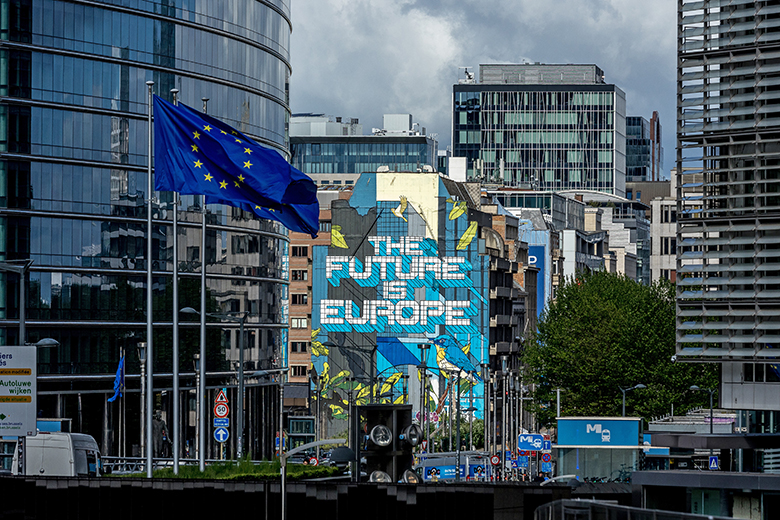
Meanwhile, the grande école’s Europe committee has proposed perhaps the most ambitious project yet: a campus in Brussels.
Sciences Po is already among the most internationally minded of French higher education institutions, having established strategic partnerships with 85 universities across 19 countries in the Asia-Pacific region, including nine joint-degree programmes. But Vassy believes that the institution did not previously think hard enough about its place within Europe.
“For a whole generation, Europe has in a way been taken for granted,” he said. “It’s a strange thing that we have a bureau in Singapore, one in China, one in New Delhi, but nothing in Brussels…We are not only an institution in France and in Europe. We are a French and a European institution.”
A campus in the Belgian capital would be Sciences Po’s first outside France and would facilitate closer connections to the EU institutions where many of its graduates eventually work, he said. For now, the campus remains a proposal rather than a firm plan but Vassy says he is examining whether there is an “operational path” to making it happen.
Source:
Omar Havana/Getty Images
Sciences Po’s renewed focus on Europe comes as Donald Trump’s attacks on science have prompted universities across the continent to court American students and academics seeking a more stable and less politicised funding environment. At Sciences Po, international applications for first-year entry rose by 35 per cent this year, with applications from the US up 55 per cent, while master’s applications from students at Ivy League universities doubled.
Nevertheless, Vassy does not believe the situation in the US heralds a major shift in the global balance of power and prestige: “Higher education worldwide has been structured around the United States since the 1950s and 1960s. That’s a reality and I don’t expect that will change,” he said, adding that he hopes to deepen Sciences Po’s collaborations with US universities.
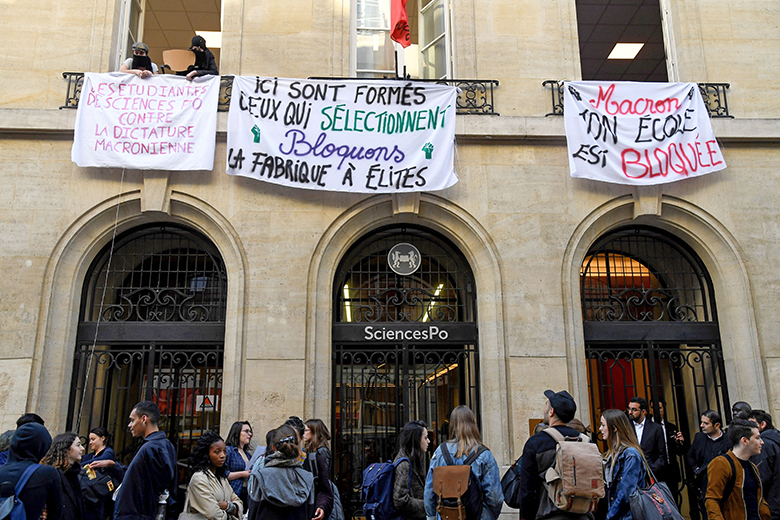
As for domestic admissions, those have always been highly sought after – and contested. The French university sector has historically had an egalitarian ethos and only introduced the limited entry criteria that students are currently protesting about within the past decade. However, entry to grandes écoles – whose graduates typically go on to the most prestigious jobs – has always been extremely competitive, often requiring an extra year of specific preparation that only students from affluent backgrounds can afford.
Popular anger about perceived elitism was the driving force of the gilets jaunes (yellow jackets) protests of the late 2010s, and it led Macron to abolish another of his alma maters, the École Nationale d’Administration, which fed France’s elite civil service.
Source:
BertrandGuay/AFP via Getty Images
Shortly afterwards, in 2021, Sciences Po scrapped its traditional entrance exam as part of a major reform designed to make the institution more inclusive. It also introduced a requirement to attend an oral interview and to write two personal essays, giving applicants an opportunity to demonstrate their “background, interests and motivations” outside a timed exam environment.
But Vassy has now changed the balance again. The personal essays have been removed and the weighting of results in France’s national exam has been increased, although the interview remains an important part of the process.
“We felt the two personal essays were written by parents, friends [and others], including, frankly, private companies assisting students,” he said. For Vassy, the problem is easy to illustrate with reference to his own family. The son of South American political refugees, he grew up in social housing in the Paris suburbs before passing through some of France’s most prestigious educational institutions.
“My father couldn’t write my essay, but I could perfectly write the essays of my son,” he says. “I wouldn’t do it, but the thing is that there is clearly social inequality there.”
Some researchers and advocates have complained that placing more weight on the oral exam also risks favouring applicants familiar with the codes and conventions of elite institutions, while putting more emphasis on grades could penalise students who have had to juggle school with responsibilities like work or care.
Vassy conceded that wealth, family connections and “cultural capital” can shape performance in exams. But, in his view, the format also tests “personal capacities. We all know children from very privileged backgrounds that are not achieving [high grades in exams], and we know students from poor families that [perform extremely well],” he explained.
For that reason, he dismisses the “elitist” label often thrown at grandes écoles. “I don’t like the word elite because it gives the impression that there is a group that is separated from the rest of society,” he said. “But that’s not what we’re doing here. We basically take people from [all parts of society] and we educate them here and they end up in the real world in a wide range of [roles],” he said.
But he is also unwilling to pretend that studying at Sciences Po does not result in a substantial advantage. “One thing that angers people outside these walls is false modesty. I think we should acknowledge that we are a place of excellence and that your life is going to be transformed, more probably than not, positively if you come through our [doors].
“What we owe to society is to make really sure that our process of selection…is as fair and clear and transparent as possible.”