Medical Research Council Invests £50 Million in Cambridge-Led Centre for Mitochondrial DNA Diseases
The University of Cambridge will host a new Medical Research Council Centre of Research Excellence to develop therapies for mitochondrial DNA diseases, marking the first time Cambridge has led such a centre.
The Medical Research Council (MRC), part of UK Research and Innovation, has announced a £50 million investment in the MRC Centre of Research Excellence in Mitochondrial Genome Therapeutics (CoRE-MitoGT). The centre will be led by Professor Michal Minczuk of the University of Cambridge and aims to enable new treatments for potentially fatal mitochondrial DNA diseases. The announcement was made on 5 August 2026.
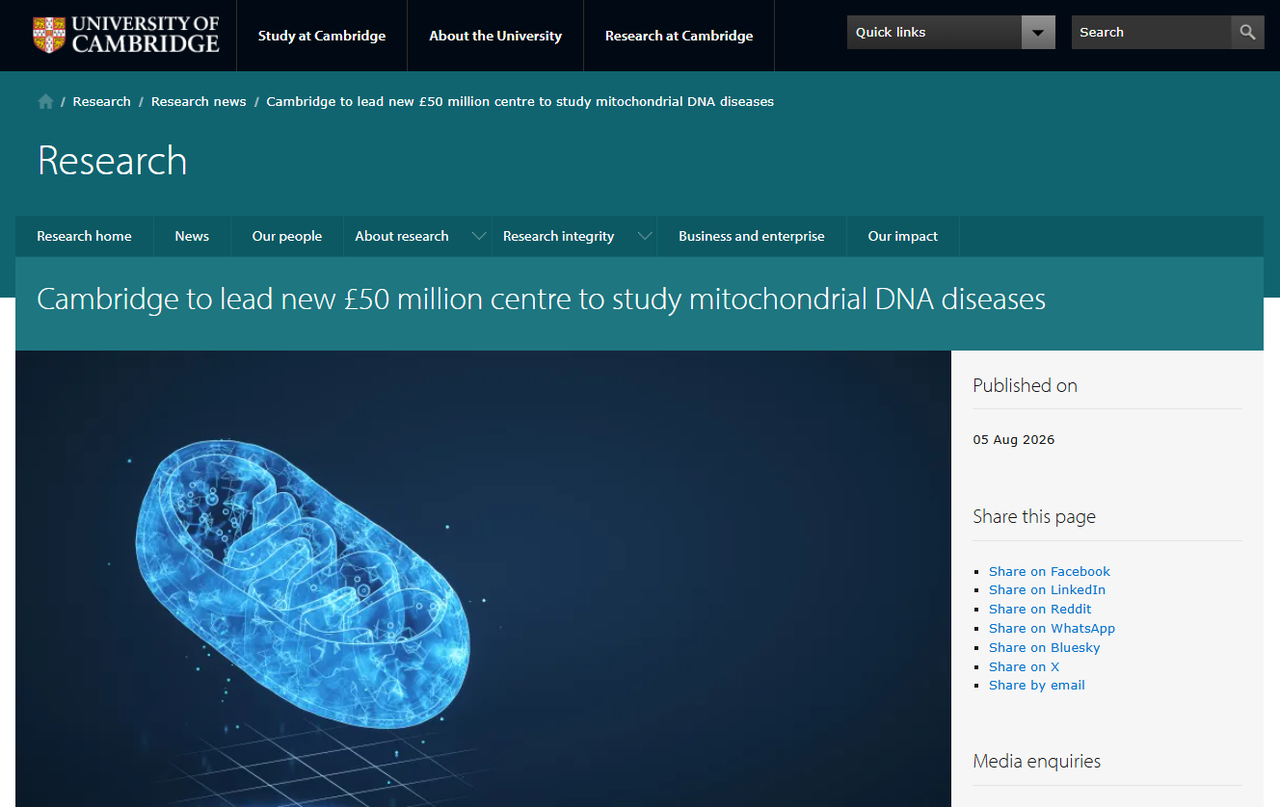
The new centre brings together experts from the University of Cambridge, the University of Birmingham, the University of Manchester, Heidelberg University, the University of Queensland, the Imagine Institute in Paris, the Lily Foundation, and industrial partners worldwide.
For the University of Cambridge, the award is its first as lead institution of an MRC Centre of Research Excellence. The university had previously joined the MRC CoRE in Clinical Trial Innovation, led by University College London, as a member of its leadership group announced in December 2025.
Cambridge builds on existing strength
The centre builds on the University of Cambridge's existing expertise in mitochondrial research at the MRC Mitochondrial Biology Unit. The unit, directed by Professor Judy Hirst, has long studied energy conversion in mitochondria and Complex I of the respiratory chain. The university describes the new centre as a long-term UK research platform intended to position the country as a global leader in mitochondrial genome therapeutics.
Mitochondrial diseases are a group of genetic disorders affecting around 1 in 5,000 people, for which no cure currently exists. Beyond inherited conditions, mitochondrial DNA mutations are increasingly linked to neurodegeneration, metabolic disease, cardiovascular failure, and age-related deterioration.
The MRC Centre of Research Excellence in Mitochondrial Genome Therapeutics will harness emerging technologies to engineer the mitochondrial genome, delivering advanced models to study common disease-causing mitochondrial DNA mutations. The goal is to define how such mutations cause disease and to translate that knowledge into therapies.
Each MRC Centre of Research Excellence receives up to 50 million GBP over 14 years, with an initial seven-year term subject to review. The MRC provides roughly 3 million GBP per year, with host organisations covering the remaining 20% under the dual-support model.
How the programme began
The MRC launched the Centres of Research Excellence model to replace its older unit and centre funding structure. A 2020 review of MRC units and centres recommended a more integrated, challenge-led, and time-limited approach. The first two centres - the MRC/BHF Centre of Research Excellence in Advanced Cardiac Therapies and the MRC Centre of Research Excellence in Therapeutic Genomics, both led by the University of Oxford - were announced on 11 December 2024.
Subsequent rounds added the MRC Centre of Research Excellence in Restorative Neural Dynamics (led by the University of Oxford with partners including Cardiff University, Great Ormond Street Hospital for Children, Imperial College London, and Newcastle University), the MRC Centre of Research Excellence in Exposome Immunology (led by the University of Manchester and the University of Oxford), and the MRC Centre of Research Excellence in Clinical Trial Innovation in partnership with the National Institute for Health and Care Research (led by University College London). The Cambridge centre is the latest in the series.
The United Kingdom has led on mitochondrial replacement therapy, which prevents the inheritance of mitochondrial DNA mutations. The MRC stated that the new centre builds on these foundations to bring together expertise from around the world and across sectors.